Recently, Professor Ding Liming’s team from the School of Chemical Engineering and Light Industry at Guangdong University of Technology published a review article on Perovskite Solar Cells. In collaboration with research teams led by Zhang Xiaoliang from Beihang University, Dong Qingfeng from Jilin University, Gao Peng from the Fujian Institute of Research on the Structure of Matter, Zhao Yixin from Shanghai Jiao Tong University, and Xiao Lixin from Peking University, the team published a paper entitled “Diverse Perovskite Materials: Progresses, Challenges and Perspectives” inAdvanced Materials(CAS Q1, IF = 26.8). Zhang Lixiu, a doctoral student from the University of Chinese Academy of Sciences, served as the first author, while Zhang Mei, a master’s student from the same university, was the co-first author.
The review systematically summarizes the research progress of solar cells based on various perovskite materials, including Organic–Inorganic Hybrid Perovskites, All-inorganic Perovskites, Lead-free Perovskites, Metal-free Perovskites, Low-dimensional Perovskites, and Single-crystal Perovskites. The article also discusses several strategies for improving solar cell efficiency, including composition optimization, Charge Transport Layers, and Interfacial Engineering. The paper presents a timeline of research progress in various types of Perovskite Solar Cells, providing important references for technological innovation and industrialization in this field.
Professor Ding Liming focuses on next-generation semiconductor materials and devices. He joined Guangdong University of Technology in March 2025 and is currently establishing his research team and laboratory, which presently consists of 13 faculty members and graduate students.
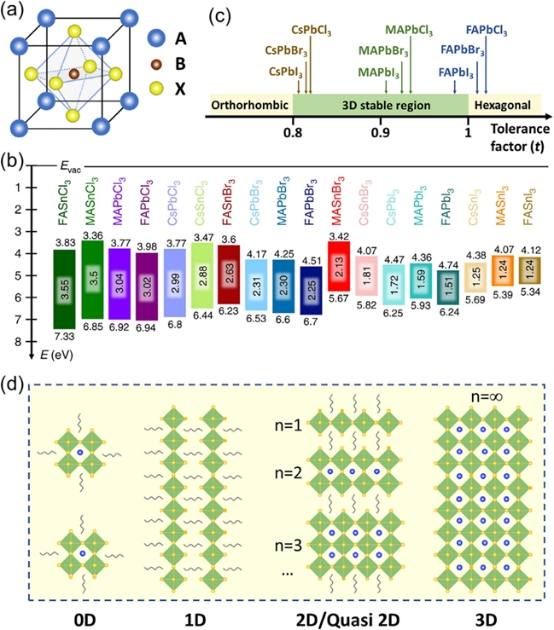
Figure1.a) The schematics of the crystal structures of perovskite. b) The energy diagrams for perovskite materials with various compositions.Reproduced with permission,[4]Copyright 2019, Springer Nature. c) The tolerance factors of perovskite materials with different compositions. d) Theschematics for perovskite materials with different dimensions.
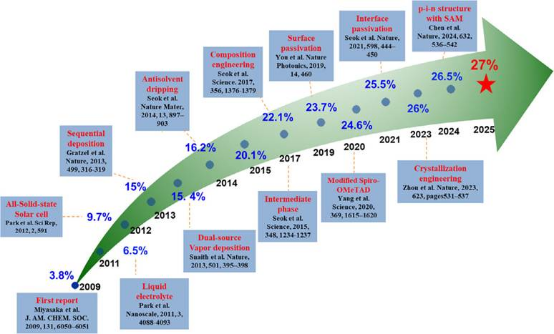
Figure2. The efficiency improvementtimeline for perovskite solar cells.

 current position:
Home
>
News & Notices
>
News
>
Content
current position:
Home
>
News & Notices
>
News
>
Content