Recently, Professor Yu Lin’s team from the School of Chemical Engineering and Light Industry, in collaboration with Professor Xing Guichuan’s team from the University of Macau, achieved a breakthrough in solar photocatalytic hydrogen production by integrating the intrinsic optoelectronic properties of halide perovskites with interfacial atomic engineering for the first time. The work was published in the top international journalAngewandte Chemie International Edition(IF = 16.1, CAS Q1 Top Journal).
By tuning the stoichiometric ratio of the FAPbBr₃ perovskite precursor, an atomically intimate FAPbBr₃/MoS₂ interface was constructed. The high-density Pb–S bonding increased the charge separation efficiency from 29% to 63%, achieving a solar-to-hydrogen (STH) conversion efficiency of 8.6%. The study reveals that charge transfer is governed by a non-equilibrium built-in electric field driven by the intrinsic carrier density gradient of the perovskite, rather than the conventional heterojunction mechanism. Density Functional Theory (DFT) simulations show that the saturated coordination interface optimizes electron transport pathways, while the lead-rich surface provides more active sites for atomic-level contact. The optimized heterojunction photocatalyst achieves a hydrogen evolution efficiency 98 times higher than that of pristine FAPbBr₃. Transient absorption spectroscopy confirms that the charge separation time is shortened from 489 ps to 112 ps, with a 2.2-fold improvement in separation efficiency.
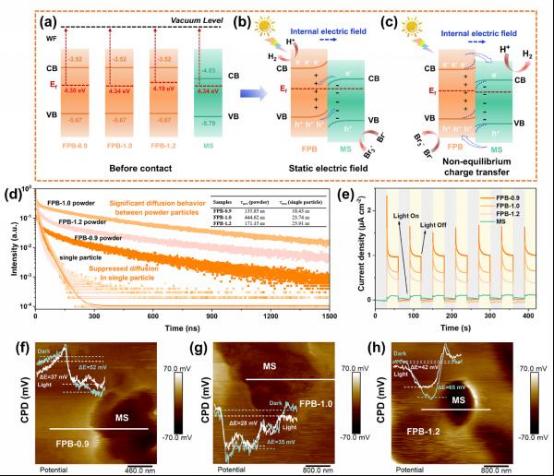
Analysis of Photogenerated Charge Dynamics in Perovskite Heterojunction Catalysts
This work, for the first time, integrates the intrinsic optoelectronic properties of perovskites (high carrier density and long diffusion length) with interfacial atomic engineering, proposing a carrier-density-gradient-driven non-equilibrium built-in electric field mechanism for charge separation, providing new insights and design strategies for high-efficiency perovskite-based heterojunction catalysts.
The first author is Master’s student GuoChanghai (Class of 2022). The corresponding authors are Professor Yu Lin and DistinguishedAssociate Professor Peng Shaomin from the School of Chemical Engineering and Light Industry, and Professor Xing Guichuan from the University of Macau. Guangdong University of Technology is the primary affiliation of the paper.
Paper link
https://onlinelibrary.wiley.com/doi/abs/10.1002/anie.202506436

 current position:
Home
>
News & Notices
>
News
>
Content
current position:
Home
>
News & Notices
>
News
>
Content