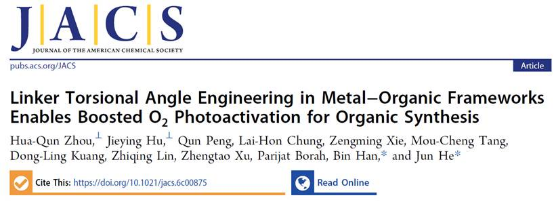
Recently, Professor He Jun’s team from the School of Chemical Engineering and Light Industry published important research findings in the internationally renowned journalJournal of the American Chemical Society(JACS). The research team discovered that by adjusting the torsion angle of a tiny structural unit — the linker — in Metal–Organic Framework Materials (MOFs), they could precisely control the generation of different Reactive Oxygen Species (ROS), much like turning a knob, thereby enabling highly efficient and highly selective organic synthesis.
Reactive Oxygen Species are highly reactive oxygen-containing substances commonly encountered in daily life. For example, the browning of a sliced apple left exposed to air is caused by the activity of ROS. In chemical synthesis, scientists use light and catalysts to activate oxygen in the air, generating ROS to drive chemical reactions. This approach is environmentally friendly, sustainable, and holds broad application prospects. However, different ROS exhibit distinct characteristics: Singlet Oxygen and Hydroxyl Radicals possess extremely strong oxidizing abilities. Like a “shotgun”,they react aggressively but can easily lead to overreaction and unwanted by-products. In contrast, Superoxide Radical Anions exhibit moderate oxidizing ability and function more like “precision-guided missiles”,efficiently driving reactions while minimizing side reactions, making them ideal for highly selective synthesis. The key question is how to selectively generate Superoxide Radical Anions instead of other ROS according to specific reaction requirements.
Using the “molecular torsion angle” as a regulatory handle, the researchers designed a pair of “molecular twins” — two structurally similar nickel-based MOFs. The two materials were nearly identical, differing only in the torsion angle of one key structural component, namely the linker: Ni-TTPz-α, featuring a planar linker configuration, and Ni-TTPz-β, featuring a twisted zigzag linker configuration. The study found that the planar material (Ni-TTPz-α) can efficiently generate Superoxide Radical Anions, with a generation rate 15 times higher than that of the twisted counterpart, whereas the twisted material mainly produces Singlet Oxygen and exhibits significantly inferior overall performance.
In the photocatalytic oxidative coupling of benzylamine to form imines (an important reaction in which imines serve as key intermediates for pharmaceuticals and fine chemicals), the performance difference between the two materials is clearly evident: The planar MOF achieved a catalytic yield as high as 99%, demonstrating potential for industrial applications.
This finding reveals, for the first time at the molecular level, how a slight “twist of the linker” can significantly influence the overall performance of a material, providing a new strategy for designing next-generation photocatalysts.
Guangdong University of Technology was the first affiliation of the paper. Graduate students Zhou Huaqun and Hu Jieying from the School of Chemical Engineering and Light Industry were the co-first authors, and Professors He Jun and Han Bin were the corresponding authors. DOI:10.1021/jacs.6c00875

 current position:
Home
>
News & Notices
>
News
>
Content
current position:
Home
>
News & Notices
>
News
>
Content