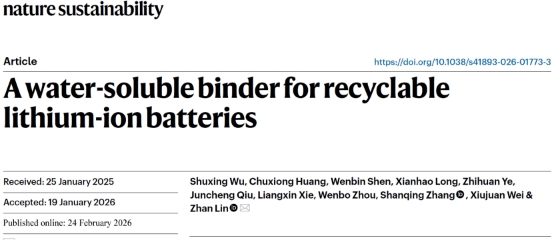
Recently, Professor Lin Zhan’s team achieved original progress in the direct recycling and reuse of spent lithium-ion batteries. The team addressed the key scientific challenge of difficult separation of components in spent batteries by designing a water-soluble supramolecular binder compatible with both cathodes and anodes. Through hydrogen bonding and ionic interactions, the binder enables reversible dissociation in hot water, achieving rapid delamination, efficient separation, and direct regeneration of active materials. This design addresses the separation challenge at the source of battery architecture, fundamentally transforming the conventional battery system. Through a functional binder design, it enables a “stable operation–efficient separation–direct recycling” pathway, significantly simplifying recycling processes and reducing energy consumption. The results were published in theNature Sustainability. Guangdong University of Technology is the sole affiliation. Associate Professor Wu Shuxing is the sole first author, and Professor Lin Zhan is the sole corresponding author.
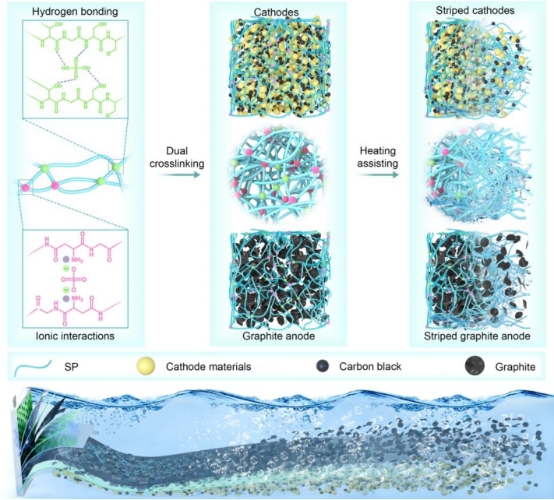
With the rapid development of the electric vehicle industry, global lithium-ion battery deployment continues to expand and is gradually entering a large-scale retirement phase. Efficient recycling and reuse of battery resources has become a critical issue in the energy and environmental sectors. Direct recycling preserves and restores the structure of electrode active materials and is considered an ideal pathway for spent battery recycling. However, in practical battery systems, strong adhesion from binders hinders effective separation of active materials, becoming a key bottleneck for direct recycling. This study starts from battery design at the source and develops a supramolecular water-soluble binder that can effectively replace conventional commercial binders. The binder is compatible with both cathode and anode materials. Its internal hydrogen bonding and ionic interactions dissociate upon heating, enabling rapid dissolution in hot water and efficient separation and regeneration of spent battery components. This work breaks the traditional “use first, recycle later” passive model, enabling batteries to be inherently designed for efficient recycling from the outset and providing a key solution to closed-loop recycling of lithium-ion batteries.
Paper link: https://www.nature.com/articles/s41893-026-01773-3#data-availability

 current position:
Home
>
News & Notices
>
News
>
Content
current position:
Home
>
News & Notices
>
News
>
Content