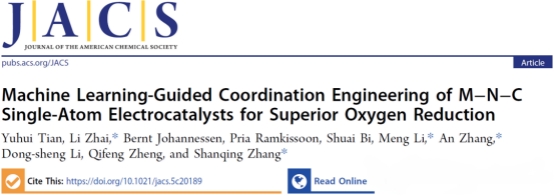
Recently, Professor Zhang Shanqing’s team, in collaboration with the Australian Synchrotron and City University of Hong Kong, made new progress in the design of single-atom electrocatalysts. They proposed a machine-learning-guided coordination engineering strategy to precisely regulate the local coordination structure of M–N–C single-atom catalysts, enabling efficient oxygen reduction reaction (ORR). By integrating Density Functional Theory (DFT) calculations with machine learning algorithms, the team analyzed structure–activity relationships across 312 M–N–C single-atom catalyst models and identified a low-dimensional interpretable descriptor Eemb/sin(CN) (where Eemb is the metal embedding energy and CN is the coordination number), providing a new paradigm for rational design of high-performance electrocatalysts. The results were published in the top international chemistry journalJournal of the American Chemical Society, with Guangdong University of Technology as the primary affiliation.
Single-atom catalysts, featuring atomically dispersed active sites and exceptional catalytic performance, represent a frontier in catalysis research. This study innovatively integrates high-throughput DFT calculations with machine learning-based data mining, systematically screening combinations of 26 transition-metal centers and 12 coordination configurations. A key descriptor, Eemb/sin(CN), was extracted from complex datasets, simultaneously quantifying metal–support interaction strength and coordination geometry. It unifies the understanding that early transition metals (e.g., Mn, Fe) require higher coordination to weaken overly strong oxygen adsorption, while late transition metals (e.g., Cu, Pd) benefit from lower coordination to enhance intermediate binding. Based on this design principle, the team precisely synthesized a Cu-SA/N–C catalyst rich in Cu–N₃ motifs via a defect engineering strategy. Experimental characterization confirmed that its local coordination environment is dominated by pyrrolic nitrogen. Compared with conventional Cu–N₄ sites, it exhibits significantly enhanced ORR activity: The half-wave potential reaches 0.886 V (vs. RHE), surpassing commercial Pt/C (0.872 V). The zinc–air battery achieves a peak power density of 191.3 mW cm⁻² with excellent long-term stability.
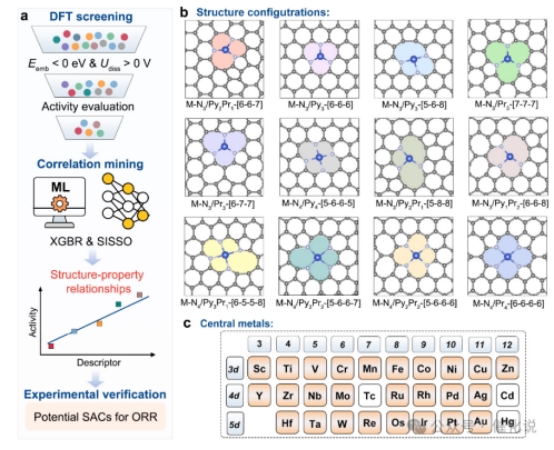
This work breaks through the “black-box trial-and-error” design bottleneck of single-atom catalysts and establishes a full-chain rational design paradigm integrating “theoretical screening–algorithmic discovery–defect engineering–performance validation”.It not only provides a transferable methodology for ORR catalyst development but also highlights the great potential of interpretable machine learning in accelerating the development of next-generation energy conversion materials. The work provides new insights into the design of sustainable electrocatalytic systems and is expected to facilitate the transition of single-atom catalysis from fundamental research to device applications.
Paper link: https://pubs.acs.org/doi/10.1021/jacs.5c20189

 current position:
Home
>
News & Notices
>
News
>
Content
current position:
Home
>
News & Notices
>
News
>
Content